In Costa Rica there are six different species of toucans.
These big birds, with large beaks and beautiful colors, live mostly in tropical areas. You will be able to see them in different parts all over the country.
Toucans inhabit from the tropical forests of the southern part of Mexico to the north of Argentina.
You will find toucans in the forests and tropical savannah as well.
They are omnivores and normally live between 15 to 20 years.
Types of Toucans in Costa Rica
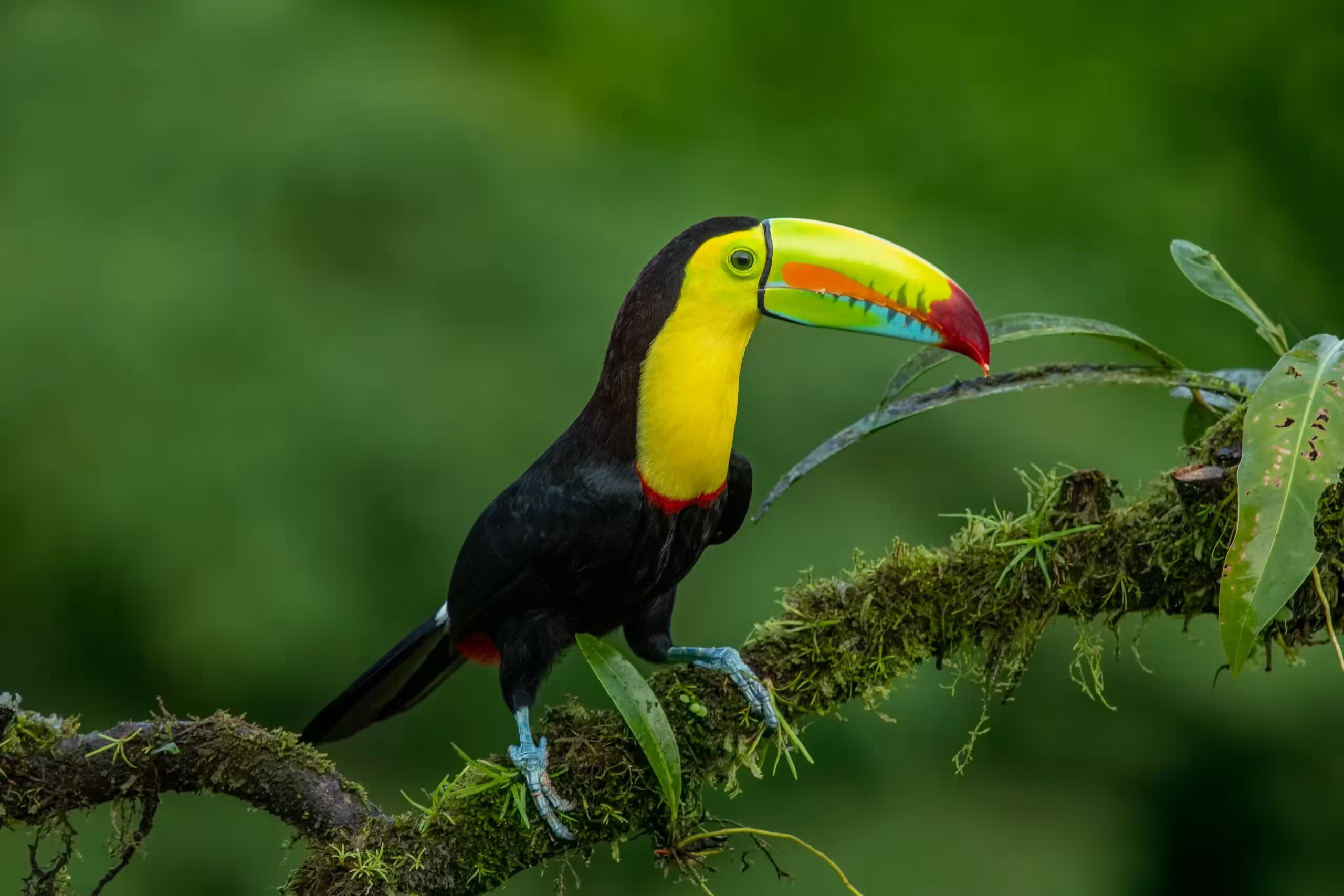
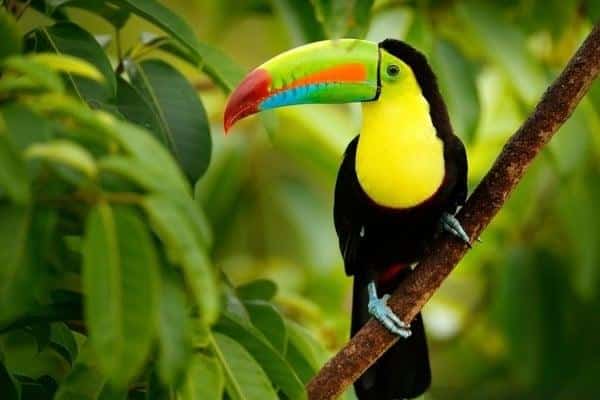
Keel-billed toucan
Its scientific name is Ramphastos sulfuratus.
Keel-billed toucan
Other names are sulfur-breasted toucan or rainbow-billed toucan.
This colorful member of the Latin American toucan family often inhabits humid forests.
You will see “keel-billed” toucans in the lowlands or hills of the Caribbean.
Another place to see them is also in the forest places of the North Pacific.
Its plumage is mostly black with some yellow parts. They measure between 42 to 55 cm on average.
This specie of toucan eat a large number of fruits.
What they usually do is to use their large beak to pierce the fruits, and then, they set their heads back to swallow it.
Other things they eat are insects, eggs of other birds, or lizards.
Black-mandibled toucan
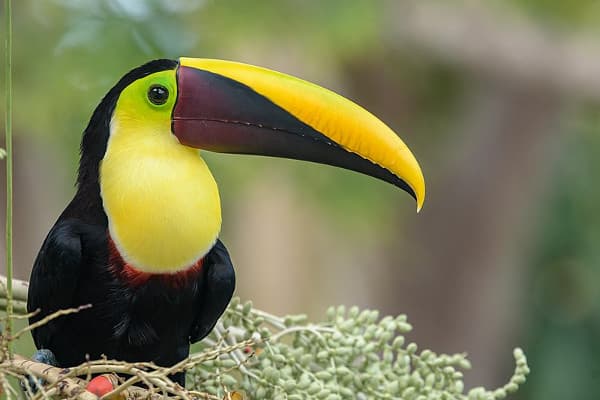
Most of the plumage of this species of toucan is black. The upper chest and throat are yellow with a red border.
Black-mandibled toucan
Its beak has two colors, and females have a slightly shorter beak.
Their habitat is from the Andes of Peru, in Ecuador, Colombia and Venezuela,
and Costa Rica.
Black-mandibled toucan adapts to different types of habitats.
It is one of the two largest types of toucans that exist alive nowadays, the toco toucan. They measure between 47 to 61 centimeters on average.
Fiery-billed Aracari
This bird breeds only on the Pacific slopes of southern Costa Rica and western Panama.
Fiery-billed Aracari
Its scientific name is Pteroglossus frantzii , and sometimes people call them Frantz’s Aracari.
Like the other species of toucan, the fire-billed aracari has brightly colors and a large bill.
This species of toucans normally measures around 43 cm.
They breed only on the Pacific slopes of southern Costa Rica and western Panama.
Collared Aricari
Its scientific name is Pteroglossus torquatus.
Collared Aricari
This toucan is small but very colorful. It inhabits places like tropical jungle and humid forests.
Among the places where they can be found are the Nicoya Peninsula, the Caribbean slope and parts of Guanacaste.
You can learn more about the Collared Aracari toucan on Wikipedia.
Emerald Toucanet
Male and female are very similar, in this species of toucans.
Emerald Toucanet
They often measure between 30 to 35 cm long. Although, the female is usually a little smaller, and they also have a shorter beak.
This species of toucans are generally green color, and have a red tail tip.
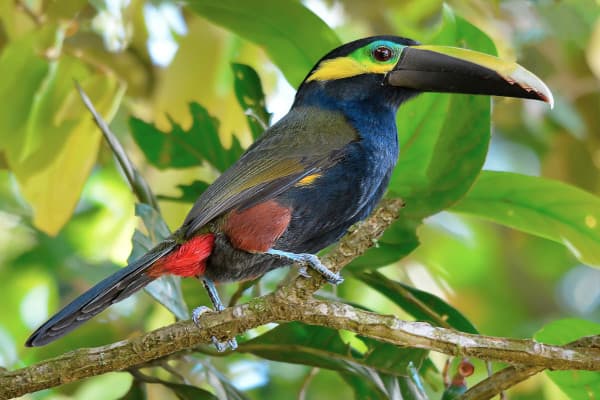
Yellow-eared toucanet
This species of toucan is relatively large, in relation to the other species.
Yellow-eared toucanet
It differs in color from the female, in that the male has a yellow stripe, and the female
has a brown crown.
You will find them in the humid forests of Central America.
To see the toucans and other types of birds, book a private bird watching tour with junglelifecr
Want to see it for yourself?
Join our Bird Watching in Costa Rica’s Rainforest
Updated for 2026: the six species and their current names
Since this guide was first written, bird taxonomy has moved on and two of the names above are now out of date. The bird we called the Black-mandibled toucan is today treated as the Yellow-throated Toucan (Ramphastos ambiguus); the Costa Rican form, with the chestnut lower bill, is the swainsonii subspecies you'll find labelled "Chestnut-mandibled" in older books. The Emerald Toucanet was split in 2016 and the Central American bird is now the Northern Emerald-Toucanet (Aulacorhynchus prasinus).
So the current list of toucans in Costa Rica is: Keel-billed Toucan, Yellow-throated Toucan, Collared Aracari, Fiery-billed Aracari, Northern Emerald-Toucanet and Yellow-eared Toucanet: still six species, four of them common enough that a patient visitor can see them in a single trip.
How to tell the two big toucans apart
The Keel-billed Toucan has the rainbow bill: mostly green, with orange on the sides and a red tip. It is the smaller of the two big toucans, and its call is a low, frog-like croak, and most people hear it before they see it.
The Yellow-throated Toucan is larger and darker, with a two-tone bill: yellow along the top, dark maroon-brown below. Its call is unmistakable: a loud, yelping series that Costa Ricans hear as "Dios te dé" ("God gives you"), often delivered from a bare treetop at dawn. If you hear it in Bijagua, look up at the tallest snag around.
Where to see toucans near Río Celeste and Bijagua
Bijagua sits on the wet, Caribbean-influenced side of the Tenorio and Miravalles volcanoes, which is exactly the forest the two big toucans and the Collared Aracari like. On our reserve, 15 minutes from the Tenorio Volcano National Park entrance, the Keel-billed Toucan and the Collared Aracari are the two you're most likely to see, and the Yellow-throated Toucan is heard almost every morning even when it stays high.
The Northern Emerald-Toucanet lives higher up, in the cloud forest on the slopes of Tenorio Volcano, and the Yellow-eared Toucanet is the scarce one: a lucky sighting on the Caribbean slope rather than something to plan a trip around. The Fiery-billed Aracari never comes this far north; for that one you need the southern Pacific.
Best time of day and year to see them
Toucans are resident all year, so there is no bad season, but there are better hours. The first two hours after sunrise and the last two before sunset are when they feed and call; in the heat of midday they sit still inside the canopy and are close to invisible.
Look for fruiting trees rather than for the birds: guarumo (Cecropia), figs and wild avocados draw toucans, aracaris and every other fruit-eater in the forest, and a good fruiting tree can hold a mixed group for half an hour. From February to May, in the breeding season, pairs are especially vocal and easier to locate by ear.
Costa Rica is home to six different species of toucans. They're big birds with large beaks and beautiful colors, found in tropical areas all across the country.
The Black-mandibled toucan is the largest, measuring between 47 and 61 centimeters on average, and it's one of the two biggest living toucan species (the other being the toco toucan). Its plumage is mostly black, with a yellow chest and throat bordered in red.
Toucans are omnivores. The Keel-billed toucan, for example, eats large numbers of fruits by piercing them with its big beak and tipping its head back to swallow, and it also feeds on insects, lizards, and the eggs of other birds.
It depends on the species: the Keel-billed toucan favors the Caribbean lowlands and hills as well as the North Pacific forests, the Fiery-billed Aracari breeds only on the Pacific slopes of southern Costa Rica, and the Collared Aracari turns up in the Nicoya Peninsula, the Caribbean slope, and parts of Guanacaste.
They're the same family. Aracaris are the smaller, slimmer toucans with a longer tail and a narrower bill; in Costa Rica that's the Collared Aracari and the Fiery-billed Aracari, and they usually move through the forest in noisy groups of four to ten. The two big toucans, Keel-billed and Yellow-throated, are heavier, with a deeper bill, and are usually seen in pairs or small groups high in fruiting trees.