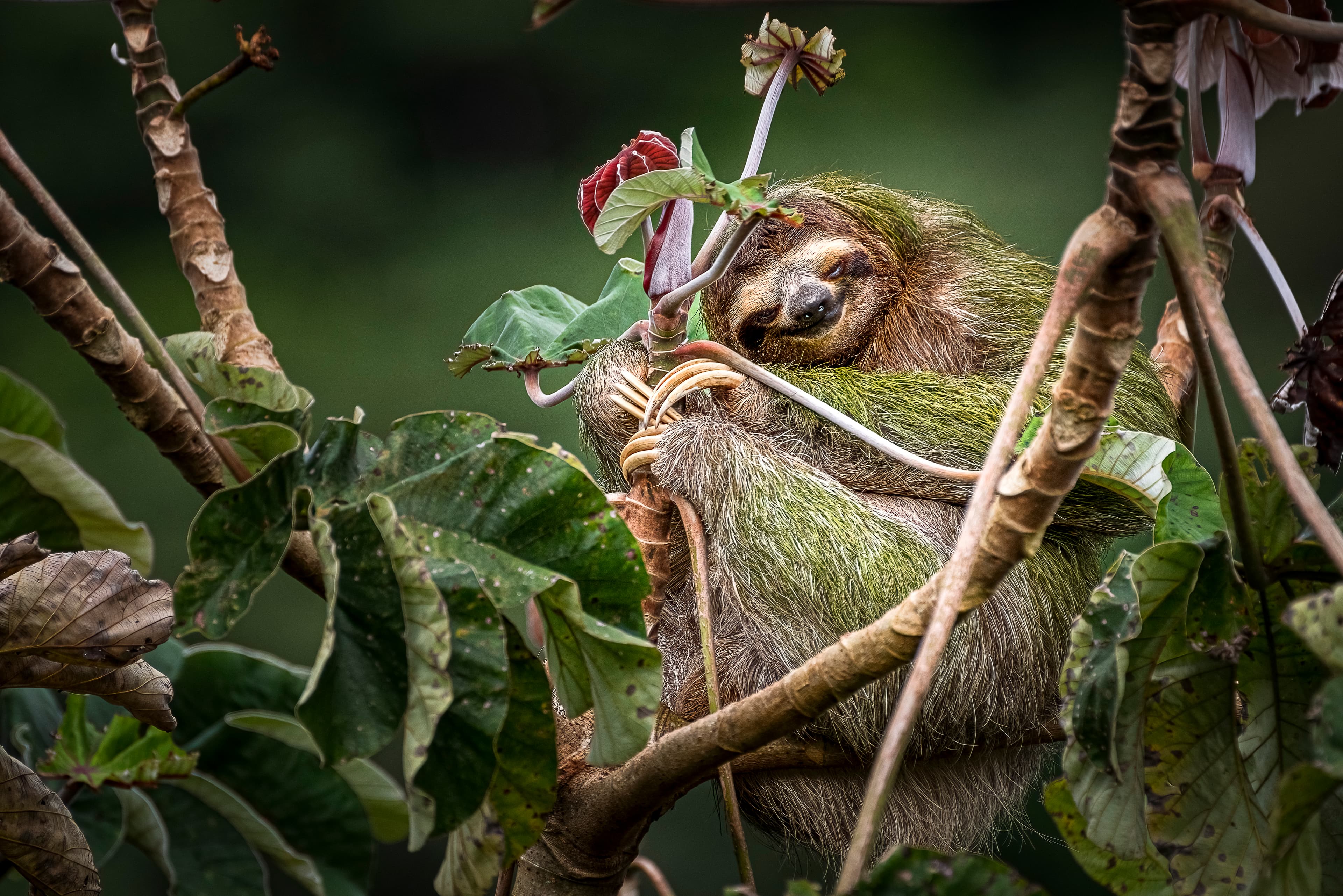

Yes, there are sloths in Costa Rica — and they are easier to find than you think
Costa Rica is home to two sloth species, and both are common enough that a well-timed walk with a good guide gives you a genuine chance of seeing one. The hard part is not that sloths are rare. The hard part is that they are almost invisible: motionless, algae-green, and forty feet above your head.
This guide covers where sloths actually live in Costa Rica, what each region is realistically like to visit, and why some places advertise sloths far more than they deliver them.
The two species you can see
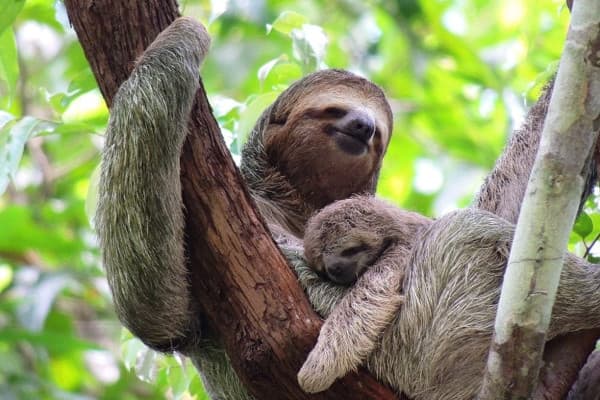
Hoffmann’s two-toed sloth (Choloepus hoffmanni) is the larger of the two, with shaggy blond-brown fur and no facial markings. It is mostly nocturnal, so daytime sightings usually mean a sleeping ball of fur wedged in a fork of a tree.
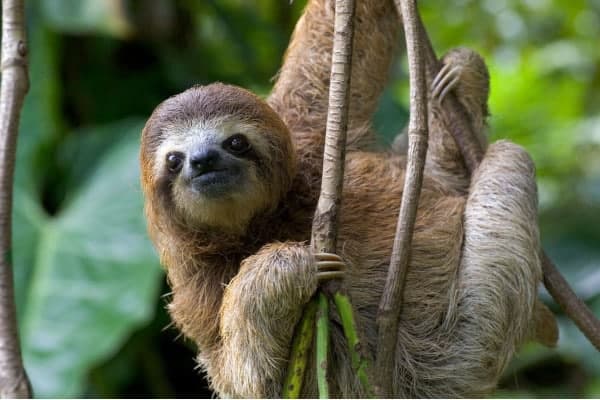
Brown-throated three-toed sloth (Bradypus variegatus) is smaller, with the dark eye mask and the permanent half-smile that made sloths famous. It is active during daylight hours, which makes it the species most visitors actually watch moving.
Both live in lowland rainforest on both coasts. Neither lives at high elevation — this matters when you plan your route.
Where to see sloths in Costa Rica, region by region
Bijagua and Río Celeste — Northern Plains
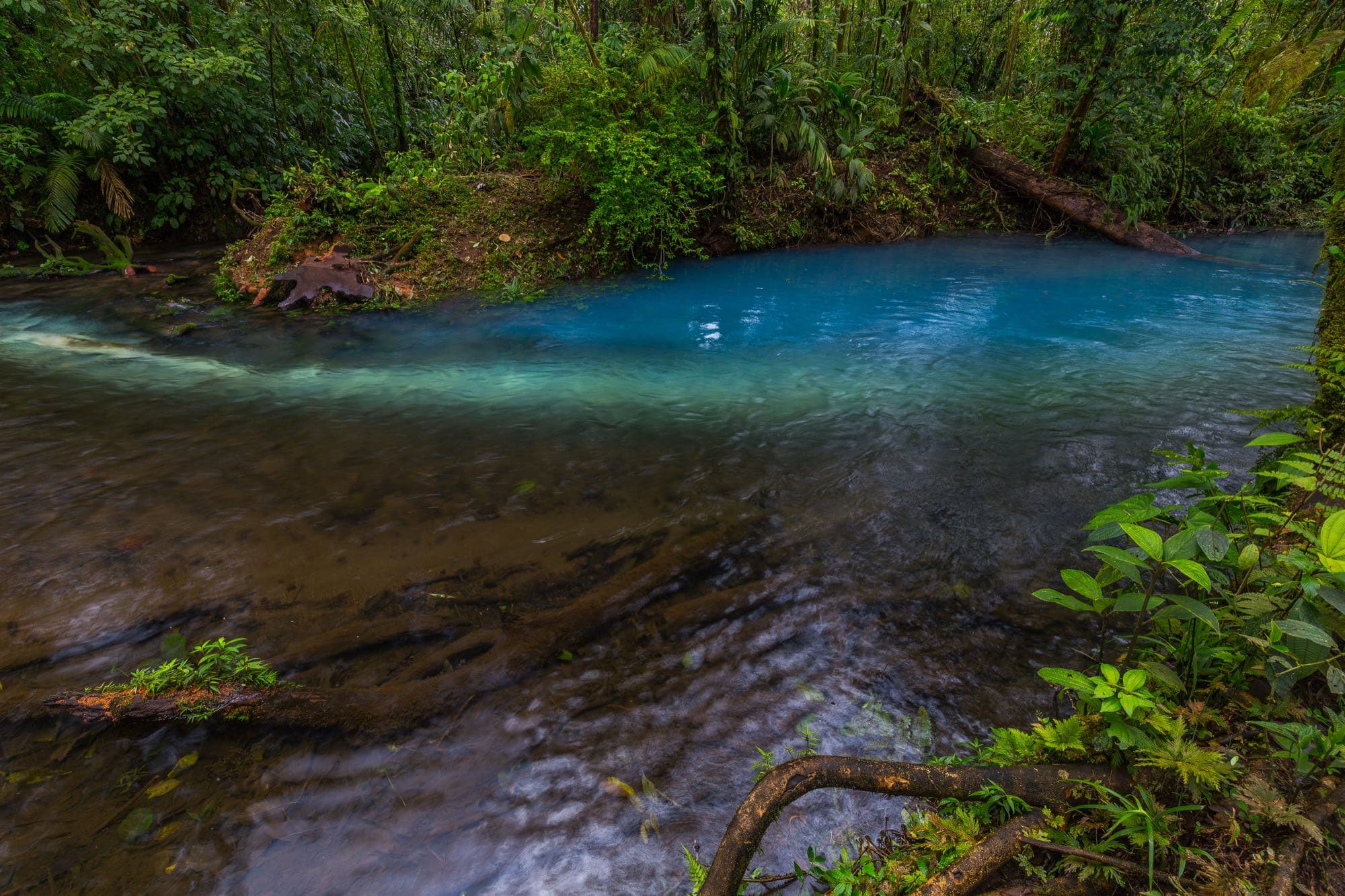
The forest corridor around Bijagua, in the foothills of Tenorio Volcano, holds both species in a landscape most visitors drive straight past on the way to Río Celeste. Because the area sees a fraction of the traffic of the Pacific parks, sightings tend to be quiet and unhurried rather than shared with a crowd.
This is where our own trails are, so treat this entry as informed rather than neutral. What we can say plainly: the region is under-visited relative to how much wildlife it holds, and it works best as a stop built into a Río Celeste day rather than a destination on its own.
La Fortuna and Arenal
The most convenient option for most itineraries, since almost everyone passes through La Fortuna anyway. Several private trails near town have become reliable for sloths, and you can usually book something the same day. The trade-off is popularity: the best-known trails can feel busy, and you will often be sharing a sighting with several other groups.
Manuel Antonio National Park — Central Pacific
The most famous wildlife park in the country, and genuinely full of sloths. It is also the most crowded place on this list by a wide margin. If you want the highest raw probability of seeing a sloth with the least planning, this is it. If you want to hear the forest while you do it, look elsewhere.
Cahuita and Puerto Viejo — Caribbean coast
The Caribbean side has a high sloth density and a much slower pace than the Pacific. Cahuita National Park is a flat, easy coastal walk where sloths are regularly spotted from the main trail. The catch is distance: it is a long drive from San José and from the Northern volcano route, so it needs to be a deliberate part of your plan, not a detour.
Tortuguero
Excellent for sloths, and the canals make for a genuinely different way to look for them — from a boat, at eye level with the mid-canopy. Access is by boat or small plane only, which keeps numbers down but also means it takes a day to reach and a day to leave.
Osa Peninsula and Corcovado
The wildest option, with the highest biodiversity in the country. Sloths are present, but in Corcovado they compete for your attention with tapirs, scarlet macaws and four monkey species. Choose Osa because you want everything, not because you specifically want sloths.
Monteverde — worth managing expectations
Monteverde is superb for cloud forest birds and orchids. It is not a strong sloth destination: the elevation is high and the temperature cool, and both sloth species prefer warmer lowland forest. Sightings happen, but if sloths are your priority, do not build your route around Monteverde.
When is the best time to see sloths?
Sloths do not migrate or hibernate, so they are present year-round. Two things shift your odds:
- Time of day. Three-toed sloths are most active in the morning and late afternoon. Midday is when everything in the rainforest, including your guide’s patience, slows down.
- Season. In the drier months some trees lose leaves, which paradoxically makes sloths easier to spot. In the green season the canopy is thicker and sightings take longer, but the forest is more active overall.
Sloths descend to the ground roughly once a week to defecate. It is the only time they are truly exposed, and it is the sighting every guide hopes for.
Wild sloths or a sanctuary?
Both are legitimate, and they are not the same experience.
Sanctuaries and rescue centres care for injured or orphaned animals. A visit guarantees you will see a sloth up close, and the good ones fund real rehabilitation work. What you are watching is an animal that cannot be released.
Wild sightings guarantee nothing. You may spend an hour looking at leaves. But you are watching an animal doing what it actually does, in the forest it actually lives in.
One rule applies everywhere in Costa Rica: holding a sloth is not a legitimate experience. Handling wild animals is prohibited, and any operator offering it is either breaking the law or keeping animals that should not be in captivity. Handling is also acutely stressful for a species that cannot express fear in a way humans easily read.
Want to see it for yourself?
Join our Sloth Tour in Costa Rica Rainforest
How to actually spot one
Most people who fail to see sloths are looking at the wrong height and the wrong shape. A few things that help:
- Look for a shape that does not belong. A sloth reads as a dark clump in a fork of a branch, not as an animal.
- Scan the canopy slowly. Sloths sleep 15 to 18 hours a day. There is nothing moving to catch your eye.
- Learn the trees. Cecropia — guarumo in Costa Rica — has an open, umbrella-like crown and is a sloth favourite. Guides scan them first for a reason.
- Go with someone who knows the individual animals. This is the single biggest factor. Guides who walk the same trail daily know where specific sloths sleep, and that turns a maybe into a likely.
- Bring binoculars. Even a good sighting is often forty feet up.
Frequently asked questions
Are there sloths in Costa Rica?
Yes — two species, Hoffmann’s two-toed sloth and the brown-throated three-toed sloth, both widespread in lowland rainforest on both coasts.
What is the best place to see sloths in Costa Rica?
For sheer probability with no planning, Manuel Antonio. For a quiet sighting, the Caribbean coast or the Bijagua–Río Celeste corridor. For convenience inside a typical itinerary, La Fortuna.
Can you see sloths without a tour?
Sometimes. Sloths are occasionally visible from roadsides and hotel grounds. But the difference in success rate between walking alone and walking with a guide who knows the resident animals is large.
Can you hold a sloth in Costa Rica?
No. It is prohibited, and any operator offering it should be avoided and reported.
How long does a sloth tour take?
Most walking tours run one to two hours. Sloths are not going anywhere, so the length is set by trail size, not by the animals.
Hoffmann's two-toed sloth is the larger of the two, with shaggy blond-brown fur, no facial markings, and mostly nocturnal habits — so a daytime encounter usually means a sleeping ball of fur wedged in a fork of a branch. The brown-throated three-toed sloth is smaller, has the dark eye mask and permanent half-smile that made sloths famous, and is active during daylight, which is why it's the one visitors most often see moving.
Three-toed sloths are most active in the morning and late afternoon, so those are the windows to plan around. Midday tends to slow everything in the rainforest down, including your guide's patience, so sightings get harder right around noon.
Monteverde's elevation is high and its cloud forest climate is cool, but both sloth species prefer warmer lowland forest, so it isn't a strong match. It's still excellent for birds and orchids — just not a place to build a sloth-focused itinerary around.
A sanctuary or rescue centre cares for injured or orphaned animals, so a visit guarantees an up-close sighting of an animal that generally can't be released back to the wild. A wild sighting guarantees nothing — you might spend an hour looking at leaves — but what you're watching is an animal doing what it actually does, in the forest it actually lives in.